

 May 05, 2026
 8 min read


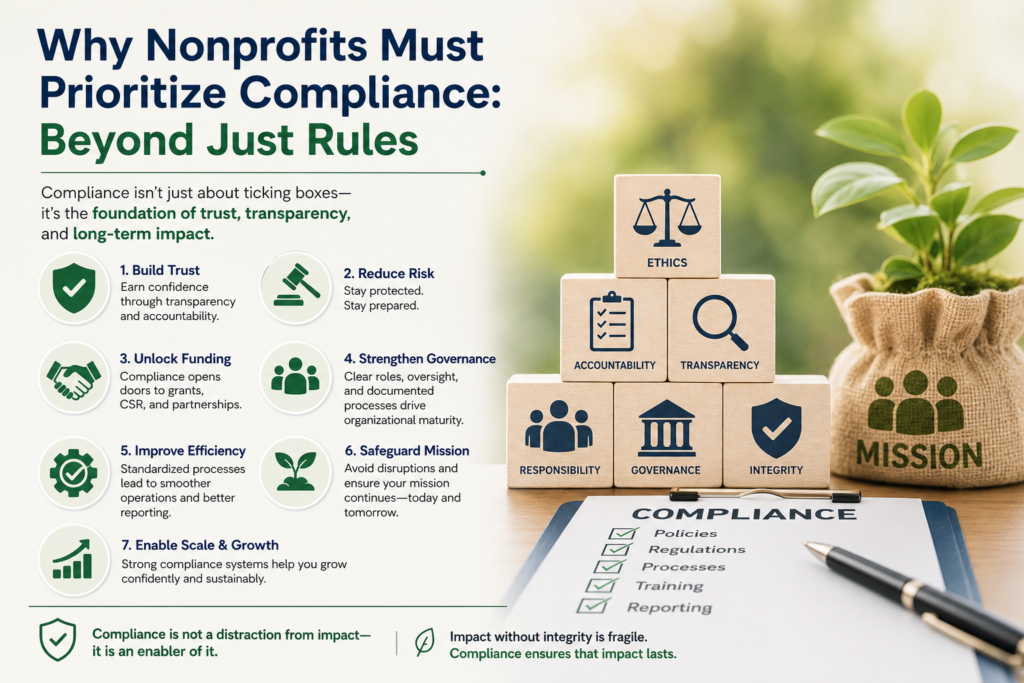
Nonprofits usually begin with a simple intention—to do something meaningful, help people, solve a problem that matters. The focus is naturally on the work itself: running programs, reaching out to communities, making an impact. In all of this, compliance often ends up sitting in the background, treated as something that just needs to be “handled somehow.”
It’s not hard to see why. Compliance doesn’t feel inspiring, which may be a result of dealing with the mundane tasks of managing forms, deadlines, rules, and documentation. After a long day of work, it can feel like an extra burden. So teams either procrastinate doing this or do the minimum required. But that approach can quietly create cracks that only show up later, and by then, they’re much harder to fix.
1.0 Building and Sustaining Trust
Think about trust for a moment. Every nonprofit runs on it—be it from donors, volunteers, or the people it serves. But it’s not something you earn just by meaning well. People start to trust you when they can actually see how things are being handled. When your records are in order, your finances aren’t confusing, and decisions aren’t kept in the dark, it reassures them. It tells them that things are being done the right way—and that makes them feel far more comfortable standing by the organization.
And when that confidence is there, the donors and volunteers are far more likely to continue supporting the organization. Without this, even small gaps can create doubt. When these things are missing, even slightly, questions start to come up, and once doubt sets in, it spreads quickly.
2.0 Legal Protection and Risk Mitigation
Then there’s the legal side, which many organizations underestimate until something goes wrong. There are rules around funding, taxation, hiring, reporting—sometimes more than expected. Failure to comply can lead to:
- Missing a requirement or misunderstanding a regulation
- Penalties and in the worst cases, losing the right to operate
For smaller nonprofits especially, recovering from that kind of setback isn’t easy.
3.0 Eligibility for Funding and Grants
Funding is another area where things become very real. Most donors today don’t just look at the cause—they look at how the organization functions. Compliance plays a role in ensuring:
- Whether the numbers add up
- Whether reports are clear
- Whether everything is being managed properly
When those basics are in place, conversations move forward smoothly. Lack of compliance can lead to: - Conversations stalling without much explanation
- Missed opportunities despite strong work
It’s frustrating, especially when the actual work is being done efficiently.
4.0 Strengthening Governance and Accountability
Within the organization, these gaps don’t always show up right away—but over time, they start to surface. This leads to issues such as:
- No one is really sure who’s handling what
- Key details not being written down anywhere
- Things starting to slip without anyone noticing right away
- People unknowingly repeating the same work
- Conversations leading to decisions that aren’t really captured anywhere
- Small mistakes slipping by until they grow into bigger issues
Early on, this easy-going, informal way of working can actually feel faster and more comfortable. But as more people join and responsibilities increase, that same approach starts to fall apart. A few basic systems in place can make a big difference and bring clarity, making everyday work smoother.
5.0 Enhancing Operational Efficiency
What many don’t expect is that the compliance work that they once found tiring can actually make things easier over time. When processes are clear and documented, it ensures that:
- Things are recorded properly
- There’s a clear way of doing them
- You don’t end up scrambling at the last minute
- Audits feel more routine than stressful
- Reports come together without pressure
- You’re not wasting time searching for information
- There’s a natural sense of order, which makes it easier for everyone to focus on their actual work instead of repeatedly fixing the same avoidable issues.
6.0 Safeguarding Mission and Long-Term Sustainability
Then there’s the question of stability. Most nonprofits don’t have a safety net big enough to handle major disruptions. A compliance failure can:
- Lead to accounts being frozen
- Force operations to pause
- Bring ongoing work to a halt
- Delay payments
- Shake the confidence people had in the organization
In extreme situations, Organizations don’t recover from this at all. That’s a tough reality, but it’s one that many overlook until it’s too late.
7.0 Enabling Scale and Growth
Growth brings its own challenges. As a nonprofit expands—more funding, more people, maybe new locations—the complexity increases. Strong compliance helps:
- When earlier ways of working no longer hold up
- Prevent things from slipping through the cracks
- Create a structure that supports growth
Compliance, when handled well, creates a structure that supports growth instead of making it chaotic.
8.0 Conclusion
At a glance, compliance doesn’t look like it has much to do with impact. It’s not visible in the same way as fieldwork or success stories. But over time, it becomes clear that without it,
even the best efforts can lose direction or come to a standstill. Compliance is not the most exciting part of running a nonprofit. But it’s one of those things that quietly determines whether the work can continue, grow, and actually last.
Looking to build stronger, more sustainable nonprofit operations?
At AlmaMate, we help individuals and organizations develop the skills needed to manage systems, data, and compliance more effectively. Whether you’re starting your journey or looking to strengthen your foundation, the right guidance can make all the difference.
Explore how AlmaMate can support your growth today.