

 Jul 22, 2026
 8 min read


This is a realization that is currently sweeping through the nonprofit sector: the “old way” of doing things is hitting a digital ceiling. For decades, the nonprofit world has been fueled by “sheer grit”—long hours, late-night coffee, and a relentless passion for the mission. We’ve managed to change lives while relying on disconnected tools, manual spreadsheets, and siloed data just to keep the lights on.
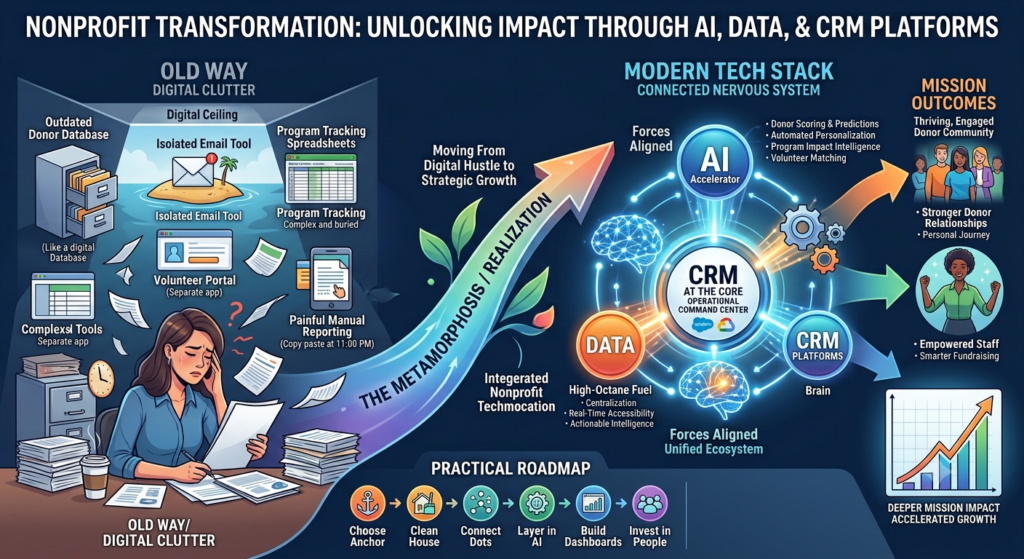
But today, we are witnessing a paradigm shift. The modern nonprofit tech stack is no longer a collection of random software; it is evolving into a unified ecosystem where AI, Data, and CRM platforms work in perfect harmony. When these three forces align, they don’t just “store information”—they drive smarter decisions, forge stronger donor relationships, and create deeper mission outcomes.
Many organizations have invested in powerful platforms like Salesforce or Microsoft Cloud, but they’re not using them effectively. This isn’t just a passing tech trend; it’s a metamorphosis in how we operate, measure success, and scale our reach.
Here is a deep dive into why this new tech stack matters, how it functions in the real world, and how you can turn your platform into your organization’s greatest strategic asset.
The Great Uncoupling: Moving From “Digital Clutter” to a Connected Nervous System
If you look at the average nonprofit’s digital toolkit, it usually looks like a junk drawer. It’s a cluttered, exhausting mix of tools that don’t speak the same language:
- The Donor Database: An outdated system that feels like a digital filing cabinet.
- The Email Tool: Living on its own lonely island, disconnected from giving history.
- The Volunteer Portal: Handled in a third, separate app.
- Program Tracking: Buried in a complex spreadsheet that only one staff member truly understands.
- Reporting: Built manually (and painfully) via “copy-paste” at 11:00 PM the night before a board meeting.
Individually, these tools might be “fine.” Together? They’re a massive bottleneck. When data lives in silos, your fundraising team has no idea what your program team is doing. Your supporters—the very lifeblood of your mission—experience inconsistent, “clunky” communication because your systems aren’t sharing notes. You end up asking a major donor to volunteer for an entry-level task because the system didn’t flag their history.
The modern nonprofit tech stack solves this by creating one connected “nervous system.” In this model, the CRM acts as the single source of truth (the brain), AI handles the repetitive “boring stuff” (the reflexes), and integrated data ensures a seamless experience for everyone involved. The result is a nonprofit that runs with the intelligence and speed of a modern digital startup.
1. The CRM at the Core: Your Operational Command Center
The foundation of this new world is the CRM (Constituent Relationship Management system). But today’s CRM is so much more than a glorified place to track tax receipts. It is the heart of the stack. Whether you’re using Salesforce Nonprofit Cloud, Microsoft Cloud for Nonprofit, or HubSpot, a modern CRM is your operational headquarters.
It allows you to track every single interaction—not just “who gave what,” but who volunteered, who attended a webinar, who opened your last three newsletters, and who benefited from your services. It allows you to personalize communication at a massive scale and connect marketing, finance, and program data into one unified view. The CRM is no longer a “nice-to-have” storage unit; it is the strategic platform upon which your entire mission operates. When the CRM is healthy, the entire organization has a “360-degree view” of the people who make the work possible.
2. Data: The High-Octane Fuel That Powers the Engine
If the CRM is the heart, data is the fuel. The traditional challenge nonprofits faced wasn’t a lack of data—it was having too much scattered data and no way to make sense of it. Without clean, high-quality data, even the most expensive CRM will stall out on the runway. In this new era, data plays three critical roles:
- Centralization: All your campaign, volunteer, and program data flows into one place. This organizes disconnected datasets and ensures everyone is looking at the same version of the truth.
- Real-time Accessibility: Data is always up-to-date. This allows you to pivot mid-campaign. If a fundraising push isn’t hitting the mark on Tuesday, you know by Wednesday—not three weeks later when the campaign is already over.
- Actionable Intelligence: Once unified, data stops being a boring list and starts being a strategic roadmap. This is exactly where AI comes into play to “activate” that information.
3. AI: The Accelerator That Turns Data Into Decisions
AI is the biggest disruption the nonprofit sector has seen in decades, but let’s clear one thing up: it’s not just about chatbots or writing clever social media captions. AI is fundamentally transforming how we understand our supporters. It takes data from being “stored” in a vault to being “activated” in the field.
What AI actually does for your team:
- Donor Scoring and Predictions: AI can analyze past giving patterns to predict who is likely to stop giving (lapse) and who is secretly ready for a major gift conversation. This transforms fundraising from a guessing game into precision targeting.
- Automated Personalization: You can send 5,000 highly relevant messages and customized impact stories at once, making every donor feel like they are your only priority.
- Program Impact Intelligence: AI can analyze program data to identify trends and measure impact more accurately than manual reporting ever could, helping you win bigger grants.
- Volunteer Matching: AI-driven tools can recommend opportunities to volunteers based on their specific skills and interests, dramatically boosting engagement and retention.
Crucially, AI isn’t here to replace your staff. It’s here to eliminate the “data tax”—the repetitive, manual work that leads to burnout—allowing your team to focus on what humans do best: building real relationships and telling the stories that change hearts.
Smarter, Proactive Fundraising
With unified data and AI insights, fundraising becomes proactive rather than reactive. You start guiding supporters on a personal journey. Retention rates climb when you stop guessing what your donors want and start knowing based on their actual behavior.
More Effective, Data-Driven Programs
When program data flows into the same system as your fundraising data, you gain a holistic view of your impact. You can see exactly how a specific INR 10000 donation directly influenced a beneficiary’s outcome. This doesn’t just make for better “feel-good” stories; it guides better future planning and resource allocation.
Better Supporter Experiences
Supporters today expect the “Amazon experience.” They want to be known. The new tech stack allows you to deliver consistent, meaningful interactions across every channel—from your website to your email newsletters—ensuring the donor feels like a partner, not a transaction.
Ending the “Nonprofit Hustle”
AI cuts down the workload in areas like data entry, email drafting, and donor research. This means your staff can do more with less, reducing the “hustle” culture that so often leads to talented people leaving the sector for the corporate world.
Building Your New Tech Stack: A Practical Roadmap
Moving to this ecosystem doesn’t have to happen overnight. You can’t just “buy” impact; you have to build it.
- Step 1: Choose Your Anchor. Select a CRM platform that can grow with you and integrates easily with the tools you already love.
- Step 2: Clean the House. Data quality is everything. High-quality data is non-negotiable. Deduplicate your records and set clear rules for how data should be entered moving forward.
- Step 3: Connect the Dots. Integrate your core tools—email, donation pages, and accounting—so they all feed into the CRM “brain.”
- Step 4: Layer in AI. Start small. Use AI for one thing, like donor scoring or automated thank-you notes, and scale up once you see the “win.”
- Step 5: Build Dashboards That Matter. Ensure your leadership can see fundraising performance and program outcomes in real-time, not just in a PDF at the end of the quarter.
- Step 6: Invest in Your People. Adoption is the only metric that matters. Invest in ongoing training and empower “internal champions” to lead the way.
Conclusion: A Future Driven by Intelligence
The future of the nonprofit sector won’t be defined by how many emails we blast out or how many events we host. It will be defined by how intelligently we use technology to turn data into meaningful change.
The new nonprofit tech stack—where AI, Data, and CRM work together—is giving us the ability to make smarter decisions, deepen our relationships, and operate with unmatched agility. Those who embrace this transformation will thrive in a world where efficiency and personalization determine success.
The digital future of our sector isn’t some far-off “someday.” It’s already here, and it’s powered by these three forces working seamlessly together to accelerate your impact like never before. It’s time to stop just “having” technology and start letting it work for you. Your mission is too important to be slowed down by bad tech.
Ready to Build a Smarter, AI-Driven Tech Stack? AlmaMate Can Help.
If you’re serious about transforming your CRM, cleaning your data, integrating your tools, and unlocking the real power of AI for fundraising and impact, AlmaMate is your trusted partner. Our experts specialize in helping nonprofits operationalize Salesforce, design scalable data systems, and implement AI solutions that actually move the needle.
Don’t let outdated processes or disconnected tools hold your mission back. Book a free consultation with AlmaMate today and start turning your technology into the engine that accelerates your impact.