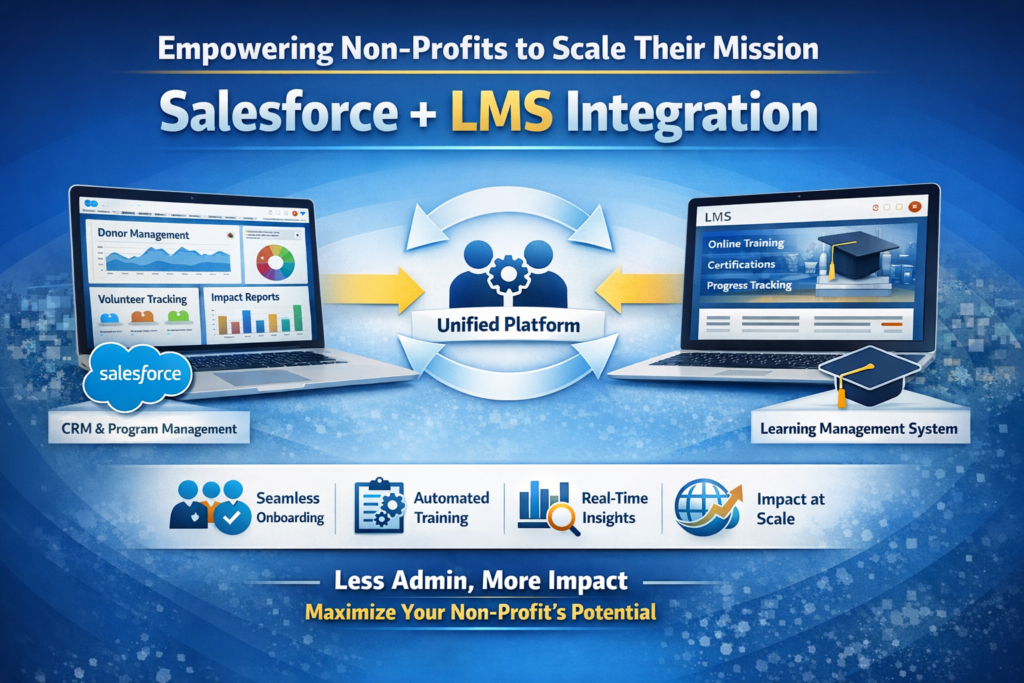
Non-profit organizations face operational challenges, including limited resources, managing diverse volunteer bases, accurately measuring impact, and scaling their work. Leveraging #NonProfitTech and integrating core systems like #Salesforce CRM with a Learning Management System (#LMS) is crucial for #DigitalTransformation and achieving #ImpactAtScale.
The Landscape of Non-Profit Challenges and Digital Solutions
Non-profits don’t struggle because they lack intent or commitment. They struggle because they are expected to do a lot with very little. Teams are small, budgets are tight, and expectations—from donors, regulators, boards, and communities—keep increasing. Every process that consumes time or energy eventually shows up as a problem somewhere else. Usually, in the field where it matters most.
Training is a good example of this. Almost every non-profit understands that training is essential. Volunteers need to be prepared before they interact with communities. Staff need to stay compliant with safeguarding, privacy, and operational policies. Partners need to understand how programs are meant to be delivered. None of this is optional.
What makes training difficult is not the lack of content or intent. It’s the operational reality. People join at different times. Roles change. Programs expand into new locations. Policies get updated more often than expected. Keeping everyone aligned becomes harder as the organization grows, even when teams are doing their best.
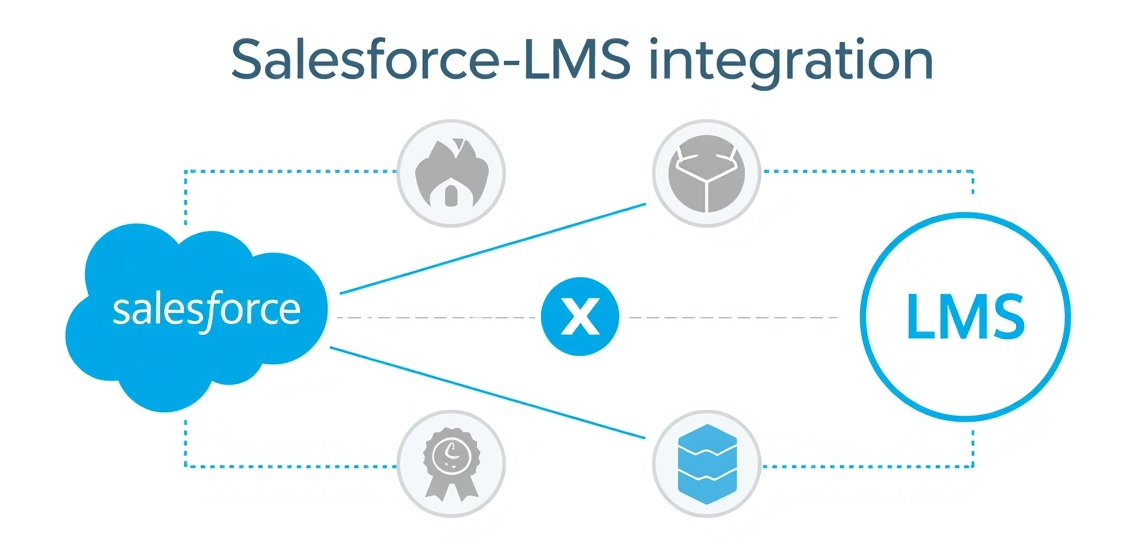
In many organizations, training is delivered through LMS, while Salesforce is used to manage volunteers, staff, programs, and reporting. Both systems are solid. Both are widely used. The problem starts when they operate independently. Teams end up moving between systems, exporting lists, updating spreadsheets, and following up manually. It works for a while. Then it becomes fragile. This is usually the point where organisations start considering a Salesforce–LMS integration. Not because they want more technology, but because the current way of working has started to slow them down.
Salesforce: The Central Nervous System for Non-Profits
#Salesforce for Nonprofits (NPSP) is a purpose-built #CRM providing a 360-degree view of constituents (donors, volunteers, beneficiaries, grantors, partners). It enables:
- Donor Relationship Management: Tracking donations, engagement, and communication.
- Fundraising Streamlining: Overseeing campaigns, appeals, and grants.
- Program and Service Management: Recording beneficiary interactions and tracking outcomes.
- Volunteer Coordination: Maintaining records, tracking hours, and managing scheduling.
- Reporting and Data Analysis: Generating insights on fundraising, program effectiveness, and donor trends.
Salesforce is foundational for #DigitalTransformation and accountability, but its native training and certification management capabilities are often limited, creating a gap that an integrated #LMS can fill.
The Synergy: Salesforce LMS Integration – Unifying Systems for Maximized Mission
Integrating #Salesforce and an #LMS creates a seamless flow of data and functionality, breaking down data silos into a cohesive ecosystem. This unified approach facilitates #DigitalTransformation by:
- Eliminating Manual Data Entry: Reducing errors and administrative burden.
- Providing a Holistic View: Offering complete constituent profiles.
- Automating Workflows: Triggering actions between systems (e.g., volunteer sign-up in Salesforce enrolls them in LMS courses).
- Enhancing Data-Driven Decision Making: Providing richer, integrated datasets for analysis.
Key Benefits of Salesforce LMS Integration
Seamless Volunteer Onboarding & Training
- Volunteers are critical to most non-profits, but onboarding them well is harder than it looks. Early enthusiasm is easy to lose. When the process feels slow, confusing, or inconsistent, people disengage quietly. They don’t complain. They just stop responding.
- Without integration, onboarding often relies on a series of manual steps. Someone approves a volunteer in Salesforce. Someone else sends training links from LMS. Progress is tracked somewhere else. If one step is delayed or missed, the entire process slows down. Coordinators spend time checking, rechecking, and following up.
- With Salesforce and LMS integrated, onboarding becomes far more predictable. When a volunteer is approved in Salesforce, they are automatically enrolled in the appropriate LMS courses. Orientation, safeguarding, and role-specific training are assigned consistently, every time. No one has to remember which course goes with which role.
- From the volunteer’s perspective, this feels organized. They receive access quickly. Expectations are clear. There is a defined path from sign-up to readiness. That clarity matters more than many teams realize.
- From the coordinator’s perspective, visibility improves immediately. Training progress appears directly in Salesforce. Coordinators can see who has completed requirements, who is in progress, and who has not yet started. They don’t need to switch systems or chase updates. Over weeks and months, this saves a significant amount of time.
- It also reduces stress. When onboarding no longer depends on memory or individual effort, teams can focus on supporting volunteers instead of managing processes.
Turning Training Data Into Useful Insights
- Most non-profits already collect training data. Course completions, assessment scores, certifications—they all exist somewhere. The issue is that this data often sits in its own silo, disconnected from operational decision-making.
- LMS knows who completed a course. Salesforce knows who is delivering programs, where, and with what outcomes. Without integration, linking the two requires manual work, so it rarely happens consistently.
- Once the systems are integrated, training data becomes easier to use. Course completions and assessment results appear alongside volunteer or staff records in Salesforce. Over time, patterns start to emerge without anyone having to go looking for them.
- Teams notice which groups consistently complete training on time. They see which programs struggle with compliance. Better-trained teams deliver more consistent outcomes. These aren’t dramatic insights. They’re practical ones. And they help teams adjust how they work.
- This also changes how impact is reported. Instead of simply stating that training was delivered, organizations can show how training supports results. For donors and grant providers, that distinction matters. It shows outcome, not just activity.

Making Reporting Easier and More Credible
- Reporting is a reality of non-profit work. Whether it’s grant reporting, donor updates, or internal reviews, teams spend a lot of time pulling information together.
- When training data lives outside Salesforce, reporting becomes more complicated than it needs to be. Numbers have to be reconciled. Spreadsheets have to be checked. Confidence in the data can be uneven.
- With integration, training data becomes part of the same reporting ecosystem as programs and outcomes. Salesforce dashboards can show training completion alongside program performance. Reports can be generated without manual reconciliation.
- This doesn’t just save time. It improves credibility. Leadership teams and external stakeholders can trust the numbers because they come from a single source of truth.
Reducing Compliance Risk Without Adding Work
Compliance training is one of those responsibilities that rarely gets attention until something goes wrong. Tracking certifications manually works for small teams. As organizations grow, the process becomes fragile. In practice, missed renewals usually happen for simple reasons. Someone forgets to update a spreadsheet. An email reminder gets buried. Responsibility is unclear. None of this is unusual.
Integration helps by removing reliance on memory. Salesforce tracks expiration dates. LMS handles re-enrolment. Notifications go out automatically. When someone completes a refresher course, Salesforce updates the record. The real benefit here is peace of mind. Teams don’t have to second-guess whether certifications are current. Leadership feels more confident during audits or reviews. Compliance becomes routine instead of stressful.
Better Planning With Fewer Assumptions
One of the quieter benefits of integration is how it changes planning conversations. When training status is visible in Salesforce, it naturally becomes part of decision-making. Managers can see whether teams are actually ready before launching a program. Coordinators can identify gaps early. Leadership doesn’t need special reports just to understand where things stand. This doesn’t eliminate uncertainty, but it reduces guesswork. Decisions feel more grounded because they are based on real data.
Scaling Without Creating Chaos
Growth is often a sign of success for non-profits, but it comes with operational challenges. New programs, new locations, and new partners all add complexity.
An integrated Salesforce–LMS setup helps organizations scale more smoothly. New courses can be introduced. New roles can be mapped to training requirements. Automation ensures consistency, even as numbers increase. Instead of hiring more staff just to manage administration, organizations can rely on systems that support growth without adding friction.
More Sustainable Way to Work
Non-profits don’t need more tools. They need tools that work together. Integration succeeds when it quietly removes effort instead of adding steps. Connecting Salesforce and LMS reduces duplicate work, cuts down on manual tracking, and improves confidence in the data teams rely on every day.
Over time, this leads to fewer workarounds and less frustration. Most importantly, it gives people space to focus on what actually matters—running programs, supporting communities, and advancing the mission. From a practical, day-to-day perspective, that’s what makes this kind of integration worth considering. It’s not about technology for its own sake. It’s about making work more reliable, more sustainable, and a little easier for teams that are already stretched thin.
Automated Certification and Renewal Management
In most non-profit organizations, certifications are not optional. They sit right at the intersection of safety, trust, and accountability. If your teams work with children, vulnerable communities, health services, or sensitive data, certifications like First Aid, Child Protection, Safeguarding, or Data Privacy are part of everyday operations. When these lapse, the consequences are rarely theoretical.
What makes certification management difficult isn’t a lack of awareness. Most staff and volunteers know what is required of them. The real challenge shows up as organizations grow. What works smoothly with a small team becomes fragile once the numbers increase or programs spread across regions.
In practice, many non-profits still rely on spreadsheets, shared drives, or calendar reminders to track certification expiry. Someone “owns” the sheet. Someone else sends reminder emails. And usually, it works—until it doesn’t. A staff member goes on leave. A volunteer changes roles. A regional program adds new requirements. Over time, the system becomes dependent on individual memory rather than the process.
This is often how gaps form. Not through negligence, but through normal organizational change. Missed certifications usually start small. One renewal happens a few days late. Another gets completed, but the record isn’t updated. These things don’t cause immediate problems, so they tend to be overlooked. Then an audit comes up. Or a donor asks for proof of compliance. Or leadership requests a report, and the numbers don’t line up. That’s when the stress hits.
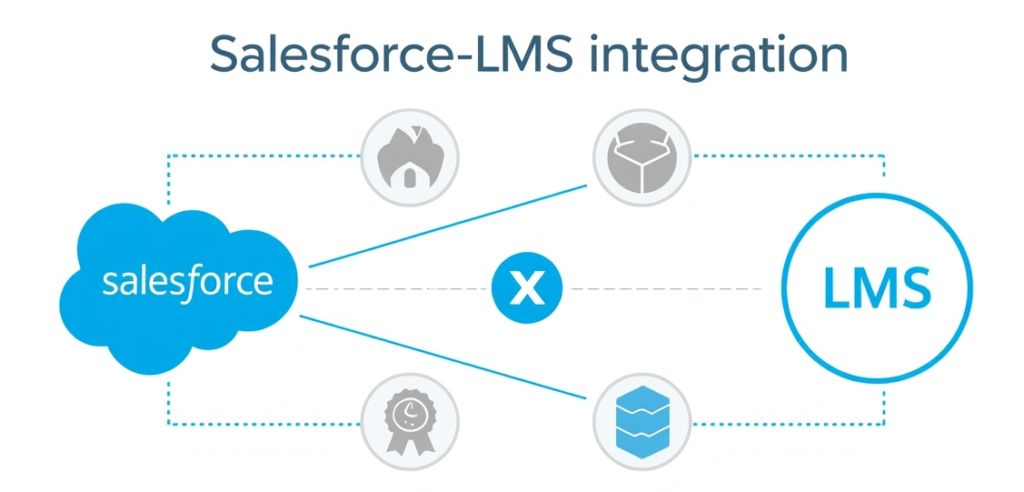
A Salesforce–LMS integration removes much of this uncertainty by shifting certification management away from manual tracking and into an automated workflow. Salesforce becomes the system that quietly monitors certification status in the background. It knows which certifications are required for which roles, when they expire, and what action needs to happen next.
When a certification approaches its expiry—say 30 days out—the system automatically triggers the renewal process. No one has to notice it. No one has to remember to check a sheet or set a reminder. At this point, LMS takes over by automatically enrolling the individual into the appropriate refresher course. This step alone saves a surprising amount of time. In many organizations, enrolment delays are not intentional. They happen because people are busy. Automation removes that dependency entirely.
The individual then receives a notification explaining what they need to complete. When written thoughtfully, these messages do not feel like system alerts. They feel like guidance. They explain why the training matters and what the timeline looks like. From experience, this clarity reduces resistance. People are more willing to complete training when it feels planned rather than reactive.
As training is completed in LMS, progress and completion data sync straight back into Salesforce. The record updates immediately. There is no waiting period and no follow-up required. This real-time sync eliminates one of the most common pain points in compliance reporting: outdated or inconsistent data. Managers benefit from this visibility. Instead of asking, “Is everyone compliant?” they can see the answer. At any point, they know who is certified, who is in progress, and who still needs support. This is especially useful when managing large volunteer groups, where direct follow-up is not always realistic.
During audits or donor reviews, this integrated approach becomes even more valuable. Reports can be generated directly from Salesforce, backed by verified training data from LMS. There is no need to reconcile multiple systems or explain discrepancies. The confidence this brings to compliance discussions is significant.
Consistency is another quiet but important benefit. In manual systems, different teams often manage renewals differently. One department sends reminders early. Another waits until the last moment. Over time, this creates uneven compliance and confusion. Automation standardises the process. The same rules apply across teams, programs, and regions. This does not remove flexibility, but it does remove ambiguity. Everyone knows what to expect.
For organisations operating across countries or regulatory environments, this structure is especially helpful. Salesforce can store region-specific certification requirements, while LMS delivers the correct training content based on role and location. This avoids the common mistake of enrolling people in the wrong course or missing local compliance rules.
Over time, the data generated by this system becomes useful in its own right. Patterns emerge. You may notice that certain certifications consistently run late, or that some teams struggle more than others. These insights allow organizations to adjust training schedules, improve communication, or redesign courses to better fit real workloads. At a human level, automated renewal systems are not about control. They are about support. Most people want to do the right thing. They just need systems that help them stay on track without adding stress.
Building Systems That Support People, Not the Other Way Around
One thing that often gets overlooked in discussions about training systems is the human cost of poorly designed processes. In many non-profits, people are deeply committed to the mission, but they are also stretched thin. When systems are confusing or unreliable, that stress shows up in small but persistent ways—missed deadlines, repeated follow-ups, frustration with “yet another platform.”
A well-integrated Salesforce–LMS setup helps reduce that friction. Instead of forcing people to remember where information lives or which email they last received, the system quietly guides them through what needs to be done. Over time, this creates a sense of predictability. People know that if a certification is due, they’ll be notified. If training is required, it will be assigned correctly. That predictability builds trust in the system.
From an operational perspective, this also changes how teams work together. Learning teams, program managers, and compliance leads no longer operate in silos. They are all looking at the same data, updated in real time. Conversations shift from “Is this data correct?” to “What does this data tell us?”. This shift matters. When teams trust the system, they spend less time double-checking and more time improving outcomes. Small improvements—better course design, clearer communication, smarter scheduling—become easier to implement because the foundation is stable.
In practice, this is what sustainable scale looks like for non-profits. Not bigger teams or more manual effort, but systems that quietly support the people doing the work, day after day.
Conclusion: Creating Impact at Scale
A Salesforce–LMS integration is often described as a technical enhancement. In reality, it is an operational shift. It changes how organizations handle growth, complexity, and accountability.
When training and certification management depend on manual effort, teams spend a lot of time reacting. Chasing completions. Fixing records. Answering the same questions repeatedly. This work is necessary, but it rarely feels rewarding.
Integration changes that. Volunteer onboarding becomes more predictable. Training status becomes visible without extra effort. Certifications renew on time. Reporting becomes less of a fire drill. These improvements may seem incremental, but together they free up meaningful capacity. That extra capacity matters. It allows program teams to focus on service quality rather than administration. It allows learning teams to improve content instead of managing logistics. It allows leadership to make decisions based on accurate, current information.
Trust also plays a role. Donors and partners increasingly expect organizations to demonstrate strong governance and compliance. When training and certification data is reliable and easy to access, those conversations become simpler and more transparent. It’s also worth noting that the most successful integrations are usually the most practical ones. They don’t start with grand visions. They start by fixing everyday problems: missed renewals, unclear training status, duplicated work. Solving these issues builds confidence and sets the stage for more advanced use cases later.
Ultimately, a Salesforce–LMS integration helps non-profits do what they are already trying to do—deliver meaningful impact with limited resources. By automating routine processes and improving visibility, organizations can move faster and respond more effectively. Not because people work harder. But because fewer things fall through the cracks. Scaling impact shouldn’t mean increasing administrative risk. AlmaMate partners with non-profits to implement Salesforce–LMS integrations that support compliance, training visibility, and long-term growth.
If you’re planning to scale programs, onboard more volunteers, or strengthen reporting for donors and regulators, AlmaMate can help you design a learning and CRM ecosystem that is stable, transparent, and built for the long run.