

 Jul 20, 2026
 8 min read


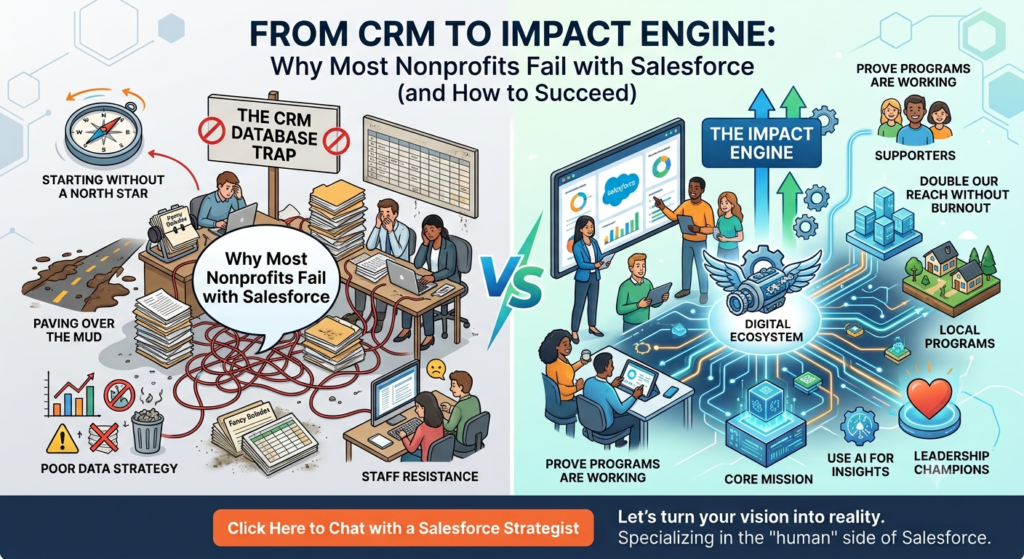
When a nonprofit team decides to adopt Salesforce, they usually do it with a sense of genuine, sun-drenched optimism. And honestly, why shouldn’t they? Salesforce is world-renowned for a reason. It has the raw horsepower to manage thousands of donors, track complex program outcomes, automate the “thank-you” notes that usually take all night, and offer the kind of data-driven insights that help senior managers sleep better at night. In a perfect world, Salesforce becomes the very heartbeat of a modern nonprofit—a true “impact engine” that seamlessly connects supporters, local programs, and the core mission.
Yet, the reality on the ground is often much more sobering and challenging.
A heartbreakingly large percentage of nonprofits never actually feel the “magic” of Salesforce. They pour their limited time, hard-earned donor dollars, and emotional energy into a massive implementation, only to find themselves drowning in confusing data a year later. They struggle with staff members who refuse to log in, processes that feel like progressing at a frustratingly slow pace, and dashboards that look pretty but don’t actually tell them how to grow.
The problem isn’t the software. Salesforce is more than capable. The real issue is the “human” side of the digital transformation. Most organizations walk into this expecting Salesforce to automatically generate impact just by existing on their servers. That “set it and forget it” expectation is almost always the first step toward a very expensive disappointment.
This isn’t just about software; it’s about a shift in how we work. Let’s explore why so many good people struggle with Salesforce—and more importantly, how you can turn a basic database into the powerhouse your mission deserves.
The Big Misunderstanding: “It’s Just a Fancy Rolodex”
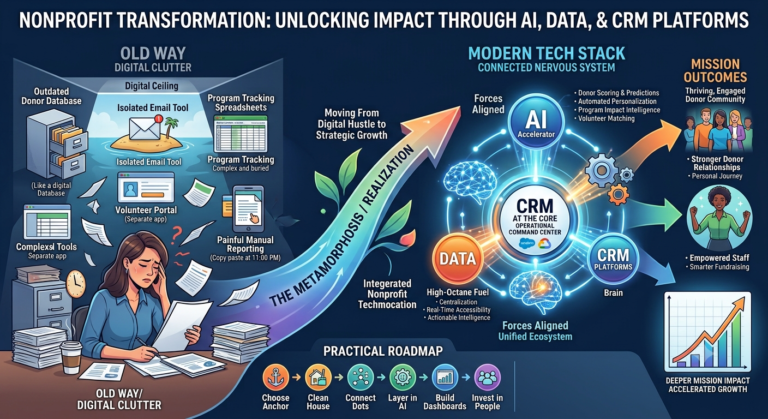
This is where the trouble starts. Many nonprofits approach the purchase thinking they are buying a CRM application suite—basically a donor database with a few extra bells and whistles. But Salesforce isn’t just a CRM software. It’s a digital ecosystem, a massive box of high-tech building blocks that can be stacked and configured in a million different ways.
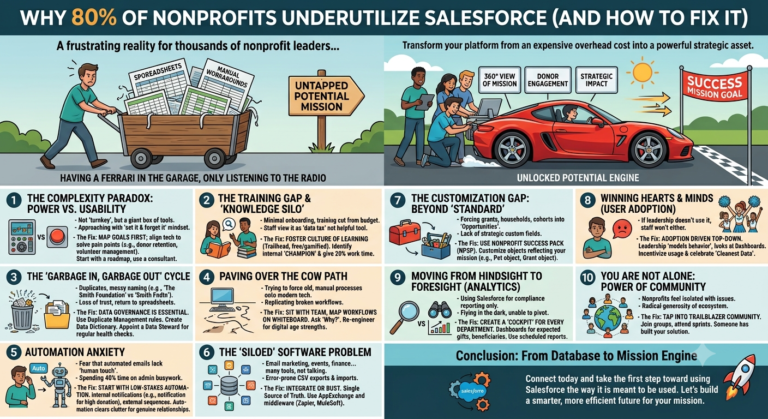
When a team treats Salesforce like a simple filing cabinet, they usually only touch about 10–20% of what it can actually do. They import their names, send a few generic emails, run a basic “Total Giving” report, and then wonder why the investment hasn’t revolutionized their fundraising.
To turn Salesforce into a true impact engine, you have to stop thinking of it as a “tool” and start seeing it as your organization’s “infrastructure.”
- A CRM is where you store information so you don’t forget it.
- An Impact Engine is a system that actually changes how your team functions day-to-day.
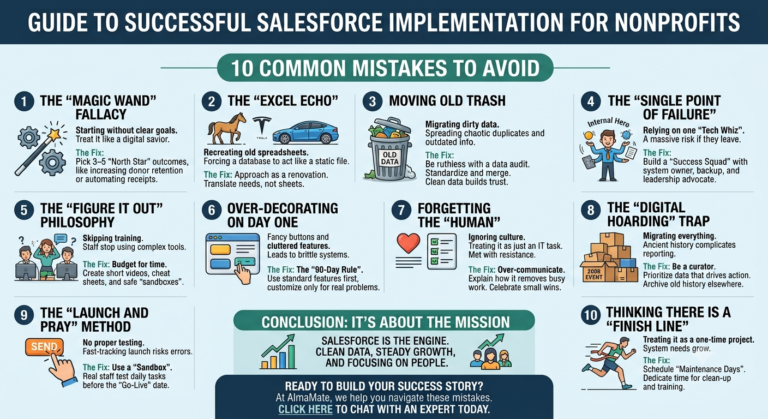
Reason 1: Starting Without a “North Star”/Direction
Many nonprofits kick off their Salesforce journey with goals that are a bit too fuzzy. You’ll hear things like:
- “We want to keep track of our donors better.”
- “We need to automate some stuff.”
- “We want all our files in one place.”
Those aren’t visions; those are just features. Impact-driven organizations—the ones which actually see their donations skyrocket—start by asking much bigger, more human questions:
- How will this help us prove to our board that our programs are working?
- How can we make a donor feel like a hero the second they click “give”?
- How will this let us make a pivot in our strategy in five minutes instead of five days?
- How can we double our reach in the next three years without burning out our staff?
Without a clear vision of impact, you’ll build a system that solves today’s paperwork problem but fails to fuel tomorrow’s growth.
Reason 2: Paving Over the Mud (Digitizing Old Messes)
This is a classic “human” mistake. A team takes their messy, manual processes—the confusing steps, the duplicate data entry, the “we’ve always done it this way” habits—and simply recreates them inside Salesforce.
The result? You just end up with:
- Automated chaos.
- High-speed inefficiency.
- A system that feels just as frustrating as the old spreadsheets, but now it costs more.
To find success, you have to be brave enough to reimagine the work. The move to Salesforce is the perfect “clean slate” moment to fix your donation workflows and volunteer journeys. Salesforce cannot fix a broken process; it can only make a process move faster.
Reason 3: Poor Data Strategy
“Garbage in, garbage out” is an old saying, but in the nonprofit world, it’s a tragedy. Many teams migrate 15 years of “unclean” data—duplicates, typos, emails from people who moved away in 2008—into the new system. Once that “trash” is in Salesforce, it starts to multiply.
Pretty soon:
- Leadership stops trusting the dashboards because the numbers look “off.”
- Fundraisers go back to keeping their “real” notes in private spreadsheets.
- The team stops updating records because the system feels like a digital junkyard.
An impact engine requires a “data diet.” You need clear rules on how names are entered, regular “housekeeping” audits, and a team-wide agreement that if the data isn’t clean, it isn’t useful.
Reason 4: Expecting People to “Just Get It”
A CRM transition isn’t a technical project; it’s a behavioural one. You are asking your team to change their daily habits. That is hard to accomplish.
When nonprofits skip the “human” side of things—training, clear guides, and constant encouragement—the staff inevitably pushes back. They fall back on old, comfortable tools, and suddenly Salesforce becomes “that thing the fundraising team uses,” rather than being the heartbeat of the whole office. A true impact engine needs everyone—from the front-desk volunteer to the CFO—to be on board. That requires empathy, patience, and a lot of hands-on support.
Reason 5: The “Kitchen Sink” Trap (Over-Customizing)
Because Salesforce can do anything, people try to make it do everything in the first week. They build custom fields for things they’ll never actually track and create complex automations that eventually tangle into a web.
The most successful systems are built on intentional simplicity. They start with the basics.
- Live in the system for 90 days.
- Only add a “custom” button if it directly helps you serve more people. A system that is easy to understand will survive staff turnover; a “fragile maze” will collapse the second your tech-savvy intern leaves.
Reason 6: Thinking There Is a “Finish Line”
If you treat your Salesforce implementation like a one-time project, you’ve already lost. An impact engine is more like a garden; it needs to grow, be weeded, and be replanted as the seasons change. Your mission will evolve. You’ll get new grants, start new programs, and meet new types of donors. If your Salesforce setup stays frozen in time, it will eventually become an obstacle rather than an engine.
Reason 7: The “Digital Filing Cabinet” Syndrome
Too many teams use Salesforce just to store history. They look backward at what happened, but they don’t use it to look forward. The real “magic” happens when you use the data to make decisions.
- Which donors are on the verge of becoming monthly givers?
- Which program is actually delivering the most “bang for the buck”?
- Where should we spend our limited marketing budget this Tuesday? The best organizations don’t just put data into Salesforce; they let Salesforce tell them what to do next.
Reason 8: Fearing the “Robot” (Ignoring AI and Automation)
We’re all a little time-starved. Salesforce can give you that time back by handling the repetitive stuff: pledge reminders, tax receipts, and volunteer follow-ups. Yet, many teams hesitate to turn on these features because they fear losing the “personal touch” or they simply feel too busy to set them up.
But here’s the irony: Automation creates the time for you to be personal. When the “robot” handles the receipt, you have the time to pick up the phone and actually talk to your donor. And with tools like Einstein AI, the system can even tell you the exact “ask” amount a donor is likely to say yes to. Ignoring these tools is like trying to mow a football field with a pair of scissors.
Reason 9: The “Top-Down” Disconnect
Salesforce will fail if the leadership team doesn’t live in it. If the Executive Director still asks for reports via email instead of looking at the dashboard, the rest of the staff will realize the system isn’t a priority.
For Salesforce to become an engine, it needs a champion in the corner office. When leaders use the data to run their meetings, the culture shifts. Suddenly, the data matters to every team and stakeholder.
Reason 10: Forgetting the “Why”
It sounds strange, but you can get so caught up in “fields,” “objects,” and “flows” that you forget you’re actually trying to save the world.
Salesforce is only an impact engine when it reflects the stories you want to tell. It should be a digital mirror of your mission—showing you the faces you’ve helped and the community you’ve built. When you reconnect the tech to the “why,” the platform stops being a chore and starts being a lighthouse that guides your entire organization toward a bigger, brighter future.
Conclusion: It’s Not a Tech Problem, It’s a Strategy Choice
Most nonprofits don’t fail with Salesforce because the software is too hard to use. They fail because they underestimate the “human” transformation required to make it work.
Salesforce succeeds when it becomes more than just software—it becomes your vision, your discipline, and your partner in the field. When you commit to these human principles, Salesforce stops being a boring database and starts being the engine that drives your mission further than you ever thought possible.
Is your team feeling more like they’re fighting their CRM rather than using it to fuel their missions?
At AlmaMate, we specialize in the “human” side of Salesforce. We don’t just “install” software; we help you build a strategy, clean your data, and train your people so that Salesforce finally becomes the impact engine you were promised. Let’s turn your vision into a reality. Click here to chat with a Salesforce strategist today.