

 Jul 22, 2026
 8 min read


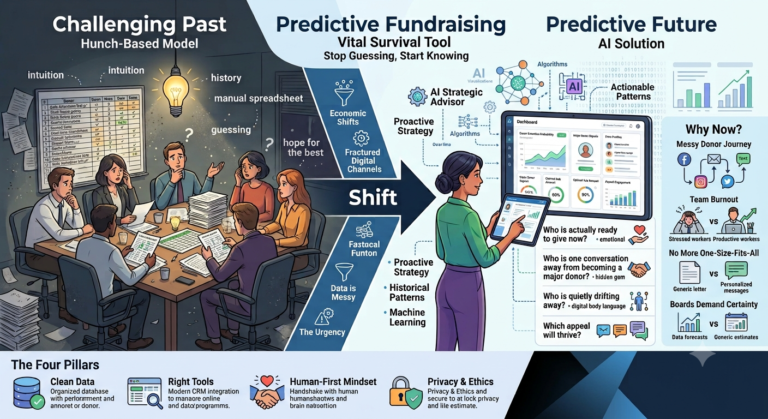
This is a shared realization sweeping through the nonprofit sector: the “old way” of fundraising is hitting a wall. For decades, fundraising has been the absolute lifeline of every mission-driven organization. It’s what pays the staff, keeps the programs running, and turns a bold vision into a tangible reality for the community. But let’s be honest—it has also traditionally been one of the most unpredictable, “gut-feeling” driven, and—frankly—exhausting functions in the building.
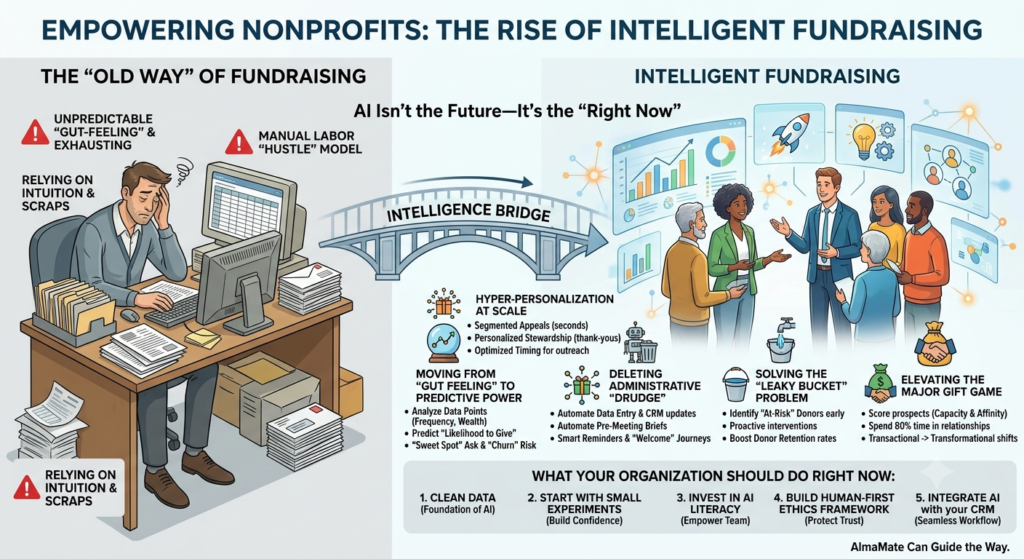
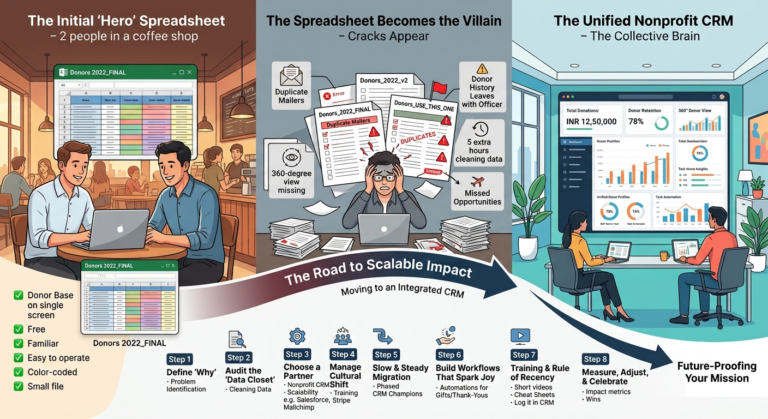
We’ve all been there: sitting in a room with a stack of donor files, relying on personal intuition, manual spreadsheets, and scraps of historical patterns to guess who might give this year. We’ve operated on the “hustle” model—where more impact requires more manual labor, more late nights, and sending out more mailers. That era is officially coming to a close.
Artificial Intelligence has entered the nonprofit space—starting as a quiet whisper of “chatbots” and quickly turning into a roar of predictive analytics and automated intelligence. It is fundamentally reshaping how we build donor relationships, how we run our year-end campaigns, and how we forecast our revenue. We are moving away from a time of manual drudgery and into a more strategic, data-informed era of “Intelligent Fundraising.”
The question isn’t whether AI will change the sector. It already has. The real question is: how quickly can your organization adapt before the gap between the “tech-forward” and the “tech-hesitant” becomes unbridgeable? Here is a deep dive into how AI is changing the game today and, more importantly, a roadmap for how you can use it to make your mission more human, not less.
AI Isn’t the Future—It’s the “Right Now”
If you feel like you’re seeing the letters “AI” everywhere, it’s because the adoption curve has gone vertical. Recent sector studies show that over 60% of nonprofits are already dipping their toes into the water—using everything from generative writing assistants to predictive donor scoring models.
Why the sudden rush? Because the traditional fundraising model doesn’t scale in a digital world. Donors now expect the same level of personalization they get from Netflix or Amazon; teams are being asked to do more with stagnant budgets; and in an uncertain global economy, “guessing” at your year-end numbers feels increasingly dangerous to a board of directors.
The Golden Rule of AI Fundraising: AI is not here to replace human fundraisers. It is here to replace the “administrative tax”—the manual work that keeps your most talented people stuck behind a desk instead of out in the community building the relationships and telling the stories that actually move the needle.
1. Moving from “Gut Feeling” to Predictive Power
In the past, a strategy meeting usually involved asking: “Who do we think might be ready for a major gift?” or “Which donors are we about to lose?” We looked at the “Top 100” list and hoped for the best.
AI replaces those shrugs with hard data. By analyzing thousands of data points—from giving frequency and event attendance to external wealth indicators and even email open rates—AI can predict:
- The “Likelihood to Give”: Identifying exactly who is primed to donate this month.
- The “Sweet Spot” Ask: Predicting the optimal donation amount for a specific individual so you don’t leave money on the table or offend them with an ask that’s too high.
- The “Churn” Risk: Spotting the subtle signs that a donor is drifting away before they actually stop giving, giving you a chance to intervene.
The Real-World Shift: Instead of a generic, expensive direct mail piece to 50,000 supporters, AI helps you find the 5,000 who are actually engaged. You send them a tailored, high-touch message, save thousands on printing and postage for the rest, and see much higher conversion rates.
2. Hyper-Personalization at Scale
Donors are tired of being treated like a generic supporter or an account number. They want to know that you see them—that you know they care about your initiative specifically, or that they’ve been a volunteer for five years.
Doing this manually for 10 donors is easy. Doing it for 10,000 is impossible for a human team. This is where AI excels. It can:
- Draft Segmented Appeals: Creating five different versions of a letter that speak to five different donor motivations in seconds.
- Personalized Stewardship: Helping craft thank-you notes that reference a donor’s specific history and the impact of their last gift.
- Optimized Timing: Determining the best day and time to send an email to a specific person to ensure it doesn’t get lost in their Friday afternoon inbox.
3. Deleting the Administrative “Drudge.”
Fundraising is notorious for “hidden” work that no one sees, but everyone feels: data entry, building complex reports for the board, researching prospect backgrounds, and manually updating CRM records. This is the work that leads to high turnover and fundraiser burnout.
AI-powered “Intelligent Departments” are now automating:
- Pre-Meeting Briefs: Automatically summarizing a donor’s entire history—their kids’ names, their last gift, their recent social media engagement—before you walk into a coffee shop for a meeting.
- The “Welcome” Journey: Handling the first six months of a new donor’s experience with a series of automated, yet highly personal, touchpoints.
- Smart Reminders: Acting as a “digital chief of staff” that tells a gift officer exactly when it’s time to pick up the phone for a check-in.
4. Solving the Sector’s “Leaky Bucket” Problem
Donor retention has been the biggest crisis in the nonprofit world for decades. Most organizations lose more donors each year than they gain. AI is finally providing the tools to shift this dynamic.
By identifying “at-risk” donors based on declining engagement levels—signals that humans often miss—AI allows you to be proactive. You can trigger a “we miss you” message or a custom impact video to a donor the moment their behavior changes, rather than waiting until they haven’t given for eighteen months and it’s too late to get them back.
5. Elevating the Major Gift Game
Major gift officers often spend 80% of their time on research and administrative logistics and only 20% of their time actually talking to donors. AI flips that ratio on its head.
By scoring prospects based on both “capacity” (wealth) and “affinity” (how much they actually care about your specific mission), AI points your team exactly where they need to go. You spend less time behind a computer screen and more time in meaningful, face-to-face human conversations. This is how you move from a “transactional” fundraising model to a “transformational” one.
6. Planning Campaigns with Scientific Precision
AI takes the guesswork out of the planning phase. It can run “simulations” based on your past data to predict how much a campaign is likely to raise. It can A/B test your creative headlines in real-time and automatically pivot your spending toward the ads or emails that are performing best. This level of intelligence leads to smarter campaigns, higher ROI, and far less wasted donor money.
What Your Organization Should Do Right Now
You don’t need to be a tech giant to start. You don’t need a six-figure budget. But you do need a plan. Here is how to prepare for the AI-driven future:
1. Get Your “Data House” in Order
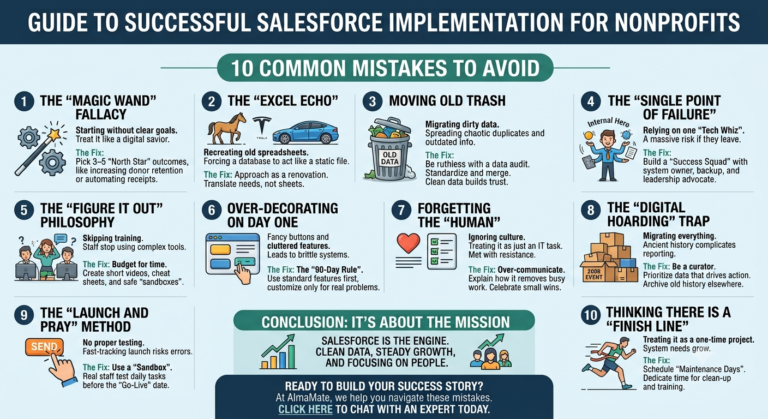
AI is only as smart as the information you feed it. If your CRM is a graveyard of duplicate records and missing addresses, AI will just give you “automated errors.” Before you buy a single AI tool, spend time cleaning your data, standardizing your entry fields, and removing the clutter. Clean data is the foundation of everything that follows.
2. Start with “Low-Stakes” Experiments
Don’t try to automate your biggest annual gala on day one. Pick a small, safe area to experiment. Use a generative AI tool to help draft social media captions or subject lines for your newsletter. Use a basic predictive tool to identify 100 “lapsed” donors for a phone-a-thon. Small, measurable wins build your team’s confidence and prove the ROI to your board.
3. Invest in “AI Literacy,” Not Just Software
Your team doesn’t need to learn how to code, but they do need to understand the “logic” of AI. They need to know how to write an effective “prompt,” how to evaluate the accuracy of an AI’s output, and—critically—how to keep donor data secure. Training is the best way to move from a culture of “fear” to a culture of “empowerment.”
4. Build a Human-First Ethics Framework
Donor trust is the most valuable asset you have. You must protect it. Create a clear policy on how you use AI. Be transparent about data privacy. Most importantly, ensure there is always “Human-in-the-loop” oversight. An AI should never send a major appeal or a financial report without a human being reviewing it first for tone, ethics, and accuracy.
5. Integrate AI with Your CRM
AI shouldn’t be a “standalone” tool that sits in a corner. Its real power is unlocked when it’s integrated directly into your CRM. When your data and your intelligence live in the same place, the magic happens. Your CRM becomes a “living” system that suggests actions in real-time, rather than a static database of the past.
The Bottom Line: Technology for the Sake of Humanity
We are entering the era of “Intelligent Fundraising.” The organizations that thrive over the next decade won’t necessarily be the ones with the most money; they will be the ones that use technology to become more authentically human.
By letting AI handle the spreadsheets, the prospect research, and the scheduling of thank-you notes, we finally get to go back to what we signed up for in the first place: changing the world through real connection.
AI isn’t replacing the fundraiser. It is empowering the fundraiser to be more present, more strategic, and more impactful. The nonprofits that act now aren’t just buying software; they are reclaiming their time so they can focus on their mission. The future of fundraising is here—and it’s smarter, faster, and more personal than we ever imagined.
Ready to Bring AI-Powered Fundraising to Your Nonprofit? AlmaMate Can Guide the Way.
If you’re ready to shift from “gut-driven” fundraising to intelligent, data-powered strategy, AlmaMate is here to help you make the leap confidently and ethically. From cleaning and integrating your CRM to implementing AI-driven donor insights, automation, and predictive workflows, our nonprofit-focused experts ensure you get real results—not complexity. Don’t let the AI revolution pass your organization by. Book a free strategy session with AlmaMate today and learn how to turn AI into your team’s biggest advantage—so you can fundraise smarter, deepen donor relationships, and accelerate your mission like never before.