

 Aug 17, 2026
 8 min read


In the Headless Salesforce approach, the traditional browser-based user interface is stripped away completely, making the system a purely API-driven engine. Instead of being made to work only in the standard Lightning interface or those that come with the Experience Cloud, your data, Apex classes, and backend functions can now be exposed solely through endpoints.
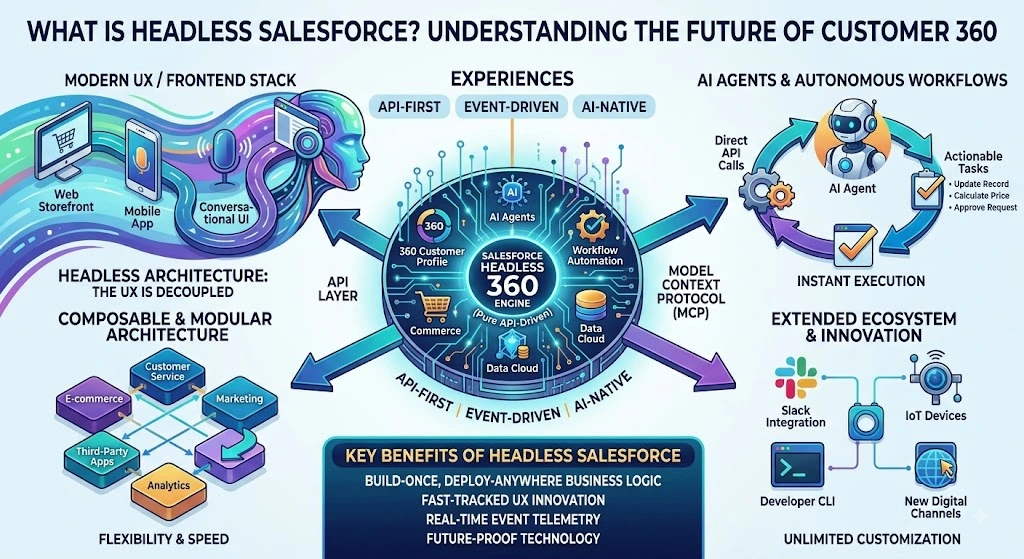
The Architectural Split: Tightly Coupled vs. Headless CRM
For over two decades, Salesforce operated primarily as a tightly coupled system. Salesforce managed the database, ran the business logic, and rendered the UI components you saw on your monitor. That setup still works great for standard back-office tasks where speed to market matters more than bespoke UX. But the moment you try to build a sub-second web app, a native iOS shopping tool, or an AI agent that executes tasks quietly in the background, native page layouts start getting in the way.
Decoupling splits those responsibilities cleanly down the middle. Salesforce handles the heavy backend lifting—data security, object relationships, validation rules, and process automation. Your developers build the frontend interface using whatever stack makes sense for the job: React, Vue, Next.js, Flutter, or native mobile code.
The Technical Framework Behind Headless Environments
A headless Salesforce setup isn’t something you simply toggle on in the admin settings. It’s an architectural pattern built on a few core technologies across the ecosystem.
API-First Core and Middleware: Headless architectures need every custom object, every record change, and every workflow to be available through APIs. The developers use GraphQL extensively to access only specific fields and not the bloated JSON objects that plagued REST APIs before. Middleware solutions such as MuleSoft and even API Gateways created internally handle request routing, transformations, and security validations between the custom frontends and Salesforce.
Model Context Protocol (MCP) for AI: The contemporary enterprise tech stack is built around AI agents working independently. Examples of solutions, such as Salesforce Agentforce and other external Large Language Models (LLMs), do not explore the software environment through the use of browser interface. Thanks to protocols such as MCP, AI has an opportunity to review the backend, validate and modify CRM without the need for any visuals.
Salesforce Data Cloud as the Operating Hub: Custom frontend built with React requires a clear data stream. Data Cloud acts as the central ingestion engine, collecting event telemetry directly from your headless applications, mobile apps, and third-party systems. It normalizes that incoming data on the fly, keeping the customer record current across every connected service.
Fixing the Real-World “Customer 360” Gap
Companies have talked about getting a “360-degree view of the customer” for years, but legacy architectures frequently broke that promise. Custom web tools operated in data silos, syncing records back to Salesforce via delayed batch jobs. Customer service agents found themselves staring at out-of-date data as support requests continued to accumulate.
Headlessness bridges these holes by altering the way data and business logic travels throughout your technology stack.
Single Source for Business Logic: Reengineering complicated business logic within multiple applications can be a maintenance headache. Thanks to the headless approach, you keep your pricing rules, discount approvals, validation rules, and other business logic in Salesforce through Apex, Flows, or CPQ engines. Your custom React storefront, mobile application, and internal Slack bots will call the same API. Once a discount rule is changed in Salesforce, this change will be reflected by all apps right away without the need for any app store updates.
Seamless Channel Switching: Customers switch channels all the time. A customer may start looking for a certain product on a native mobile app, then ask your AI-powered chatbot some technical questions about the product one hour later and complete the purchasing process through a web browser. Since every interaction is made through the same backend, session state and user identity will be consistent throughout the whole journey.
Real-Time Event Telemetry: Headless frontends do not only consume data but actively send events back to the backend. For example, when the user browses products in a particular category on your custom-built Next.js frontend, this event immediately gets tracked by Data Cloud which allows you to take some actions based on a user’s current intent.
Where Headless Can Be Helpful Implementing a headless approach means additional engineering effort, therefore it is reasonable to focus on those areas where the conventional CRM interface limits your business performance.
Bespoke E-Commerce Storefronts: Many online retailers face limitations with their stock ecommerce templates. Implementing Headless Salesforce Commerce Cloud will allow you to create custom-built Progressive Web Apps (PWAs) with superfast loading speed and unique visual design system while Salesforce manages inventory, orders, and payment process behind the scenes.
Agent-First Operational Workflows Instead of forcing service agents to manually copy and paste data across five different browser tabs, an AI agent can handle high-volume routine tasks directly. When a customer submits an address update or requests a order status check via a chat widget, an AI assistant calls the relevant Salesforce API endpoints, runs the backend logic, updates the record, and notifies the customer—finishing the work in seconds without human intervention.
Embedded Tools Inside Collaboration Apps Sales reps spend most of their workday inside messaging platforms like Slack or Microsoft Teams. Headless integrations bring CRM functionality directly into those channels. Deal status changes, access to account history, and even the approval process for discounts are possible within lightweight chat UI interfaces integrated directly into Salesforce backend endpoints.
Engineering Note: Headless means owning your frontend infrastructure. Salesforce does not render pages anymore, host the page and take care of client-side accessibility—these are the responsibilities of your frontend dev team.
The Cold, Hard Reality: Trade-Offs and Technical Challenges
Going headless is not a magic potion, and it introduces significant technical complexity to be accounted for by engineering leadership.
Additional Infrastructure Burden: Once you get away from using standard Salesforce page templates, you get a burden of hosting your frontend apps, managing CI/CD processes, configuring the right CDN routing, and securing your users’ authentication flows (OAuth 2.0 / JWT).
Risk of API Governor Limits Violation: Each action on your headless app: like clicking a button, scrolling the page or fetching data requires making a network call to your backend. In the absence of advanced caching techniques (Redis / edge networks) and sophisticated middleware management the increased number of customers interacting with the app will quickly run out of the number of daily allowed API calls allowed by governor limits of your org.
Exacerbated Technical Debt: APIs serve as an unobstructed window into your data model. If your Salesforce org has any technical debt related to custom fields, automation triggers or apexes, those flaws will be reflected in the performance and stability of your custom frontends. Fixing your backend is required to write frontend code.
Engine Ready for the Future
Going headless is not only about technical aspects of the development. Decoupling Salesforce is a conscious decision of a company about its approach to the software architecture. It transforms Salesforce into a pluggable service layer, which can be used in a wide variety of tech stacks to build web applications, autonomous AI agents, field services apps or anything else.
Transform Your Organization with an AI-First, Headless Salesforce Architecture – Guaranteed.
Moving to a Headless Salesforce configuration is one of the most critical architectural decisions your company will make in the next decade, promising to unlock unparalleled front-end agility and make your customer data truly omnichannel. But as this article detailed, the challenges of additional infrastructure management, API governor limits, and existing backend technical debt are substantial.
Don’t risk your digital future by navigating this complexity alone. Almamate specializes exclusively in guiding complex enterprises through these exact architectural transitions. Let our team of certified technical architects and integration specialists help you design, build, and deploy a secure, scalable, and API-driven Salesforce foundation that makes your developers happy and your business competitive. We handle the heavy engineering lifting of MCP, middleware configuration, and API optimization, so you can focus entirely on delivering the bespoke user experience your customers demand.
Ready to talk to a real architect about decoupling your innovation?

[CLICK HERE TO SCHEDULE YOUR HEADLESS ARCHITECTURAL READINESS AUDIT]