Nov 17, 2026
 8 min read


The Problem: Too Many Resumes, Not Enough Hours
When a major textile manufacturer in North India got in touch with AlmaMate Info Tech, their HR team was completely swamped.
They hire for all kinds of roles—factory floor production, quality control, operations, sales, admin, and senior management. Because of that, hundreds of resumes land in their inbox every single week. Yet, their recruiters were still opening every single PDF and Word doc by hand. They spent hours pulling out basic contact details, checking work histories against job descriptions, and trying to figure out who deserved a phone call.
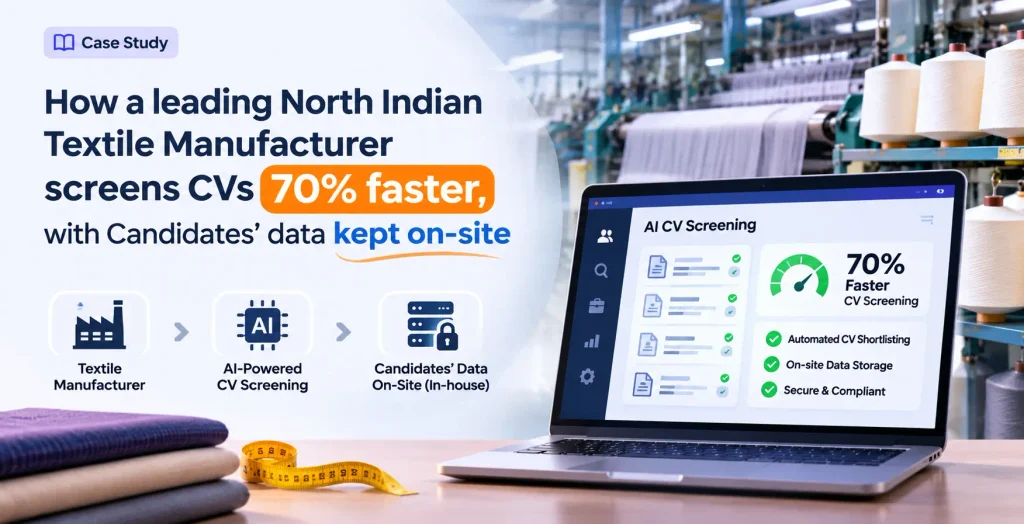
Doing everything manually caused five real headaches for the team:
- Weeks lost to sorting: Just getting through the pile of incoming applications ate up most of the HR team’s week.
- Mind-numbing copy-pasting: Recruiters spent way too much time logging basic qualifications instead of actually talking to promising candidates.
- Hit-or-miss grading: When three or four different people review stacks of CVs manually, what counts as a “good” candidate naturally shifts from person to person.
- Losing good people: Taking days just to finish the first round slowed down the whole hiring process. By the time HR reached out, top candidates had already taken jobs with faster competitors.
- Strict data privacy rules: Company leadership flat-out refused to upload confidential applicant resumes to public cloud tools or outside AI platforms.
The HR team wanted AI to clear their backlog, but there was one strict condition: every piece of candidate data had to stay inside their own building.
Our Solution: Private AI Running on Local Servers
We sat down with their HR team to map out how they actually hire and reviewed their IT security rules. Then, AlmaMate Info Tech built a custom CV screening system powered by locally hosted, open-weight AI models.
Instead of connecting to outside cloud APIs, we set up the entire system on an on-premises GPU server right inside the manufacturer’s own network. Recruiters got fast, automated screening, and not a single resume ever left their local servers.
We focused on five features the team actually needed:
Automatic CV Reading
The tool opens incoming resumes and pulls out education, past jobs, shop-floor or technical skills, certifications, and industry experience.
Smart Job Description Matching
It reads each open job description to catch the must-have qualifications and years of experience, then checks every applicant’s profile directly against what the role requires.
Clear Match Scores and Rankings
Instead of clicking through raw files one by one, recruiters get a clean list of candidates ranked by how well they fit the job. Finding the best people now takes minutes instead of days.
Simple, One-Page Snapshots
Long, messy, multi-page CVs get turned into neat, uniform summaries. Recruiters can compare applicants side by side without constantly switching between twenty open tabs.
Recruiters Still Make Every Call
We built this to support the HR team, not replace their gut instinct. Recruiters still read the summaries, double-check the details, build the final shortlist, and decide who gets interviewed.
How We Put It Together
We rolled out the platform in five practical steps so it fit naturally into how the HR team already worked:
- Learning their routine: We started by looking at their hiring volume, open roles, screening rules, and IT security boundaries.
- Setting up local hardware: Next, we built a locked-down AI setup on their own on-premise GPU server so nothing depended on outside internet connections or cloud services.
- Training the system: We tuned open-weight AI models specifically to read resumes, understand textile and corporate job descriptions, score matches, and write plain-English reports.
- Plugging into daily work: We connected the software directly to HR’s existing process so uploading a batch of CVs and checking snapshots felt easy from day one.
- Testing with real batches: Finally, we ran actual hiring batches through the tool to sharpen its accuracy, speed things up, and keep the screen clutter-free.
The Results: Less Admin Work, Faster Hires
Handing off the heavy lifting of initial screening to local AI cleared out repetitive paperwork and sped up their entire hiring timeline:
- 75% faster first-round screening: Time-to-shortlist dropped from 5 full days to under 6 hours per batch.
- 60% less admin work: Recruiters got back more than half of their admin hours, giving them time to run technical interviews and focus on onboarding.
- 100% on-site data control: Every candidate file stays behind the company firewall, wiping out third-party vendor risks.
- More time talking to people: HR shifted their focus from reading files to interviewing candidates and checking in with department heads.
- Consistent reviews: Every applicant gets weighed against the exact same criteria, making early screening fair and predictable.
- Ready for busy seasons: The system easily handles sudden spikes in applications without forcing the company to hire extra HR staff.
Privacy Built In From the Start
Keeping candidate records locked down wasn’t an extra feature we added at the end. It was the whole point of the architecture.
Because the open-weight models run right on the client’s local GPU hardware, all CV reading, data extraction, and scoring happen safely behind their own firewall. Applicant files never touch external AI APIs. For companies handling sensitive personal records, this setup proves you can use modern AI without giving up control of your data.
Why Work With AlmaMate Info Tech?
At AlmaMate Info Tech, we help businesses weave practical AI into their day-to-day work. Instead of selling rigid, off-the-shelf software that forces you to change how you operate, we build around your actual team habits, existing servers, and privacy rules.
For this North Indian textile manufacturer, the goal wasn’t chasing a flashy new HR trend. It was getting rid of tedious paperwork, bringing consistency to hiring, and keeping sensitive candidate records completely safe.
Bringing Private AI Into Everyday Hiring
This project shows how traditional industries can put modern AI to work without putting data privacy on the line. By pairing locally hosted AI models with reliable CV parsing and job matching, AlmaMate Info Tech helped a leading manufacturer build a faster, sharper, and completely private hiring process.