

 Jun 05, 2026
 8 min read


CASE STUDY
A Salesforce-powered Survivor Management System built for Chhanv Foundation — helping a frontline nonprofit manage every survivor journey with the speed, structure, and accountability it deserves.
| Client | Chhanv Foundation |
| Sector | Nonprofit | Acid Attack Survivor Welfare |
| Platform | Agentforce Nonprofit | Sales Cloud | Service Cloud |
| Solution Focus | Survivor intake, eligibility, approvals, benefit management, case tracking, reporting |
| Implementation Partner | AlmaMate Info Tech |
| Engagement Type | Full Salesforce Consulting and Implementation |
When a survivor of an acid attack reaches out for help, the response needs to be immediate, structured, and compassionate. For years, Chhanv Foundation — one of India’s most renowned and respected nonprofits in this space — was doing this work largely through spreadsheets and email chains. AlmaMate Info Tech partnered with them to change that.
The Challenge
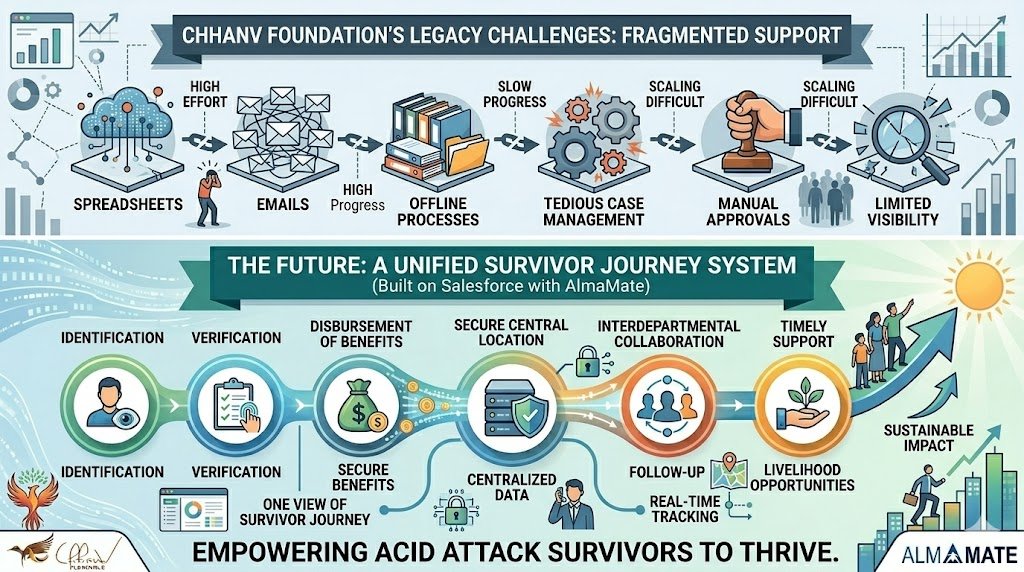
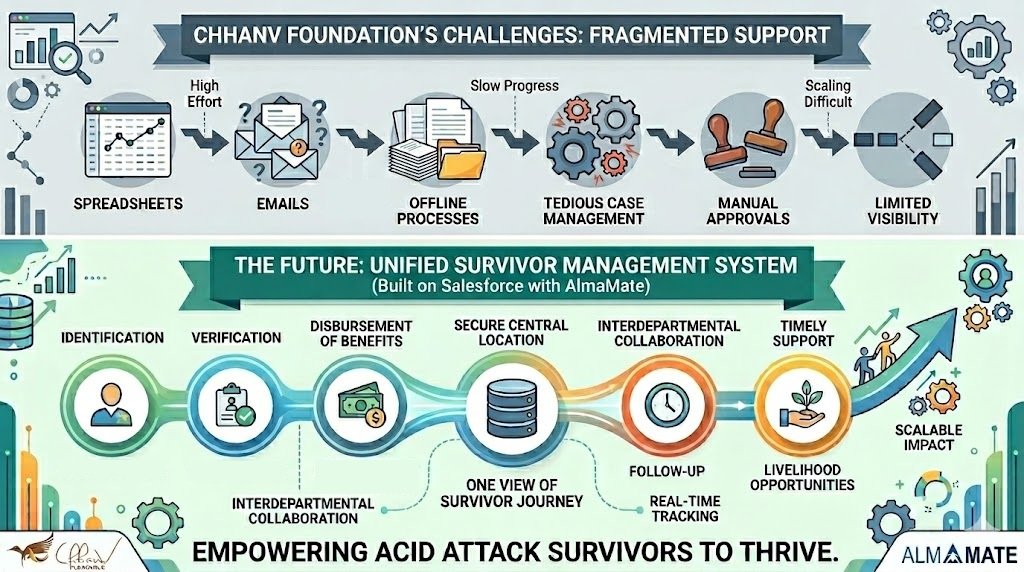
Empowering Acid attack survivors with the support they need to thrive has been the focus of the Chhanv Foundation for years. Operating programs throughout India, Chhanv has helped many acid attack survivors successfully navigate medical care, legal support, financial aid, rehabilitation, and livelihood opportunities. But as more survivors came forward to access Chhanv’s programs and more support programs were launched, Chhanv’s dependence on spreadsheets, emails, and offline processes began to show its limits. It was challenging to ensure cent per cent visibility and alignment across a survivor’s journey. Managing cases, granting approvals, and interdepartmental collaboration were very tedious and required a lot of manual effort.
AlmaMate Info Tech partnered with Chhanv Foundation to develop a Survivor Management System built with customizations on Salesforce. Through the use of this Salesforce enabled system, all information and data related to a survivor’s case can be found and stored in one secure and central location. The case tracking progresses through all the different stages of case processing from identification to verification, through the disbursement of benefits, and subsequent follow-up activities. This provides a high degree of assurance and allows the survivors to receive support in a timely and systematic manner. With the development of these systems, Chhanv can scale its programs further.
1. Background
The Chhanv Foundation provides long-term and comprehensive support to Acid attack victims. This support goes beyond treatment for immediate relief and includes medical care, legal aid, financial support, rehabilitation, and employment assistance. This involves various teams of Chhanv Foundation, and this engagement lasts for a long duration.
The number of acid attack victims continues to rise, and so does the need for the services offered by Chhanv Foundation. Their previously used method of support, which leveraged the limited utility of spreadsheets for maintaining records manually, proved to be inefficient. Important updates arrived through different sources, and tracking eligibility assessments was almost impossible. Approval histories were available through numerous email threads. In the absence of a reliable and definitive information source, the management’s ability to monitor and manage the distribution of benefits was very limited and greatly hampered. This resulted in the creation of duplicate records, delayed actions, and unfulfilled support commitments.
Chhanv, with the help of AlmaMate, developed a Survivor Lifecycle Management CRM platform using Salesforce. While creating this new structured support system, Chhanv wanted to ensure that the system operated with as much care, compassion, and concern as they offered to their clients. This enabled case support, approvals, benefit tracking, and team engagement: all in one system, while also offering the care that is required for survivors.
2. Key Challenges
| Fragmented Discovery | Survivor information flows in from websites, phone calls, referrals, NGO networks, government channels, and field teams — with no unified intake. |
| Inconsistent Verification | First responders conduct calls, field visits, and document reviews without a standard process or audit trail. |
| Undocumented Eligibility | Case histories, financial conditions, legal status, and prior support received were assessed informally, with no structured record. |
| Scattered Documents | Consent forms, ID documents, legal records, financial evidence, and certificates were stored across email and local drives. |
| Approval Gaps | Onboarding required Welfare Director sign-off; benefit allocation required COO approval — but neither had a formal workflow or audit trail. |
| Limited Leadership Visibility | Senior leadership could not see pending approvals, benefit stage, or regional caseload status without manually chasing updates. |
| No Operational Reporting | There was no way to track benefit delivery rates, officer workloads, survivor progress by region, or monthly trends. |
3. Salesforce Solution Delivered
AlmaMate has successfully created a Survivor Management System for Chhanv Foundation using Agentforce Nonprofit, Sales Cloud, and Service Cloud on the Salesforce platform. This solution has centralized information on a single, secure platform. This information was previously disseminated across various spreadsheets, email chains, and manual logs.
The organization now has a consolidated and concise view of each case, and all survivor-related data has been organized and stored. The system covers all steps in the survivor process. This starts with outreach and verification and continues with delivery and management of benefits, as well as follow-up on rehabilitation. The system empowers the staff to work promptly while supporting the survivor process, ensuring care and sustaining transparency throughout that process.
Core capabilities delivered
• Centralized intake process for capturing and managing survivor information received through multiple outreach channels
• Structured verification process conducted by first responders, including documented eligibility reviews
• Comprehensive application records covering personal background, family details, legal status, financial situation, and medical history
• Controlled onboarding workflow requiring review and approval from the Welfare Director
• Unified survivor profile serving as the primary record throughout the support and rehabilitation journey
• Assessment framework for identifying, prioritizing, and allocating support based on individual survivor needs
• Multi-level approval process with COO authorization for benefit disbursement and support allocations
• Case management capabilities for handling ongoing requests, follow-ups, and escalations through Service Cloud
• Permission-based access model tailored to the responsibilities of field staff, officers, directors, and executive leadership
• Secure repository for storing and managing sensitive documents such as identity proofs, consent forms, legal records, and certifications
• Interactive dashboards and reporting tools providing leadership with real-time visibility into operations and program outcomes
4. The Survivor Journey in Salesforce
Every survivor who comes into contact with Chhanv follows a structured, documented path within the system — ensuring no step is missed and every decision is recorded.
| Step | Stage | What Happens in Salesforce |
| 1 | Discovery | Survivor information is captured from any channel — website inquiry, phone call, referral, NGO network, government source, or field team — into a structured Survivor Inquiry record. |
| 2 | Verification | The assigned Welfare Officer, Legal Officer, or Reach-out Officer conducts calls, field visits, and document review. Findings are recorded against the inquiry record. |
| 3 | Eligibility Assessment | The team evaluates case history, identity, legal status, financial condition, medical situation, and any prior support received. A structured Eligibility Assessment record is created. |
| 4 | Application Form | A comprehensive application is completed in Salesforce: personal and family details, case narrative, legal and financial assessment, required benefits, consent confirmation, and document uploads. |
| 5 | Welfare Director Approval | The completed application is submitted through a formal approval process. The Welfare Director reviews, approves, or rejects, and the decision and timestamp are stored in the audit trail. |
| 6 | Survivor Profile Creation | On approval, a structured Survivor Profile is created — the master record that persists across the entire journey and links all assessments, benefits, cases, and documents. |
| 7 | Benefit Assessment | The team identifies and prioritises benefits based on documented need: medical support, legal aid, education, livelihood assistance, shelter, financial grants, or counselling. |
| 8 | COO Benefit Approval | Each benefit stage requires formal COO approval before execution — ensuring governance and accountability at every allocation decision. |
| 9 | Case and Follow-Up Management | All ongoing survivor support requests are tracked as Service Cloud cases with an assigned owner, priority, status, due dates, attachments, and closure notes. |
5. Leadership Dashboards and Reports
Salesforce dashboards gave Chhanv leadership real-time operational visibility — replacing manual status updates with live data across the survivor pipeline.
| Dashboard / Report | What It Shows |
| Survivor Pipeline Overview | Total survivors discovered, under verification, onboarded, and active. |
| Approval Queue | Pending Welfare Director and COO approvals with aging and assigned officer. |
| Benefit Delivery Tracker | Benefits by status (Approved, Pending, Delivered, Rejected) across all survivors. |
| Regional Caseload | Survivor distribution and case status by region and nodal office. |
| Officer Workload | Open cases, pending follow-ups, and task completion by the welfare officer. |
| Emergency Support Cases | Active escalations and time-sensitive service cases requiring urgent action. |
| Monthly Trends | Onboarding volume, benefit allocations, and case closures over time. |
| Duplication and History Check | Flags survivors with prior contact or benefit history to prevent duplicate onboarding. |
6. Delivered Impact
| Impact Area | What Changed |
| Operational Efficiency | A single platform replaced multiple spreadsheets and email threads. Team coordination improved, process steps became trackable, and time spent on manual data management dropped significantly. |
| Governance and Accountability | Every onboarding and benefit decision now has a formal approval trail. Audit history is stored in Salesforce, reducing reliance on individual memory or inbox searches. |
| Survivor-Centred Service | Need-based benefit assessment is documented and structured, enabling faster, more consistent support decisions tailored to each survivor’s situation. |
| Leadership Visibility | Directors and leadership can view pending approvals, benefit stage, officer workload, and regional caseload in real time — without waiting for manual reports. |
| Scalability | A well-structured CRM foundation that can expand to donor reporting, mobile field access, portal self-service, WhatsApp integration, and AI-assisted case summaries in future phases. |
| What Chhanv gained: From fragmented tracking across spreadsheets and emails to a single Salesforce platform where every survivor’s journey — from first contact to long-term support — is structured, visible, and governed. Leadership can now see exactly what is pending, what has been approved, and what has been delivered at any moment. |
7. Conclusion
The Survivor Management System for Chhanv Foundation is a custom-built survivor management system that goes beyond traditional CRM systems. This custom survivor management system exemplifies the foundation’s mission by providing an effective, transparent, and caring approach to managing complex survivor journeys.
This survivor management system connects the intake, verification, approval, benefit distribution, and case management systems to a single user-friendly hub. This survivor management system provides management, operational, and process control system support to administration teams. With this survivor management solution in place, administration teams are no longer burdened by the tracking of survivors or by the maintenance of multiple disparate records.
This survivor management system, thus, reallocates to Chhanv Foundation its undersupplied resources and saves its staff and supporters precious time. The system’s efficiency provides the foundation for its rehabilitation services to be available to more communities and survivors.
Fragmented tracking and administrative bottlenecks shouldn’t get in the way of your mission. AlmaMate Info Tech specializes in building customized, secure, and compliant Salesforce solutions that empower frontline teams and give leadership real-time visibility. For enquiries about this engagement or similar Salesforce implementations for nonprofits and social sector organisations, contact AlmaMate Info Tech.